



The short answer
Deck of Scurra is Print Studios stepping outside the Plinko series that made its name, and it is the most complete thing the studio has shipped. A 243-ways cascading slot where the deck itself is the mechanic, wrapped in the best-realised world in the catalogue. It also carries an 86.10% configurable build, and there is a fifteen-second way to check whether you are on it.
- 96.09% headline RTP, 20,000x max win, 243 ways with cascades. Volatility is rated 9 out of 10 by the studio, and the bonus arrives once every 209.57 spins.
- 60.9% of all return sits in the base game. The studio has now completely inverted the design it used through the Plinko trilogy, where the bonus carried up to 79%.
- Every alteration in the bonus is permanent. The deck you finish with is the deck you built, which makes late spins worth far more than early ones.
- The 86.10% build pays the same 78.72x average bonus. The cut is hidden in frequency, not in the round, so you cannot spot it by playing one bonus.
- The quick tell: the lowest build ships without feature buys. No buy button in the menu is a strong signal you are on a reduced version.
Try it yourself
Deck of Scurra at Stake
Stake carries the Print Studios catalogue including Deck of Scurra, runs on crypto, and lists the feature buy options that the reduced RTP build does not offer. Before you stake anything, open the information panel and confirm the RTP line reads 96.09%. If it says 94.19% or 86.10%, or if the Feature Buy menu is missing entirely, you are on a lower build and the same session will cost you materially more. The rest of this review explains exactly how much.
Play Deck of Scurra at Stake →Analysis based on Print Studios' published math model and figures compiled from independent listings, written 28 August 2026. Release 4 November 2025. Figures throughout use the 96.09% build unless stated otherwise.
For three games and two years, Print Studios built the same machine. A thin slot whose only job was producing scatters, bolted to a Plinko board that carried everything worth having. We priced all three, and the pattern was hard to miss: the base game returned 22.1% of total return in Pine of Plinko, 21.3% in Pine of Plinko 2, then finally 57.2% in Pond of Plinko when the studio rebuilt it.
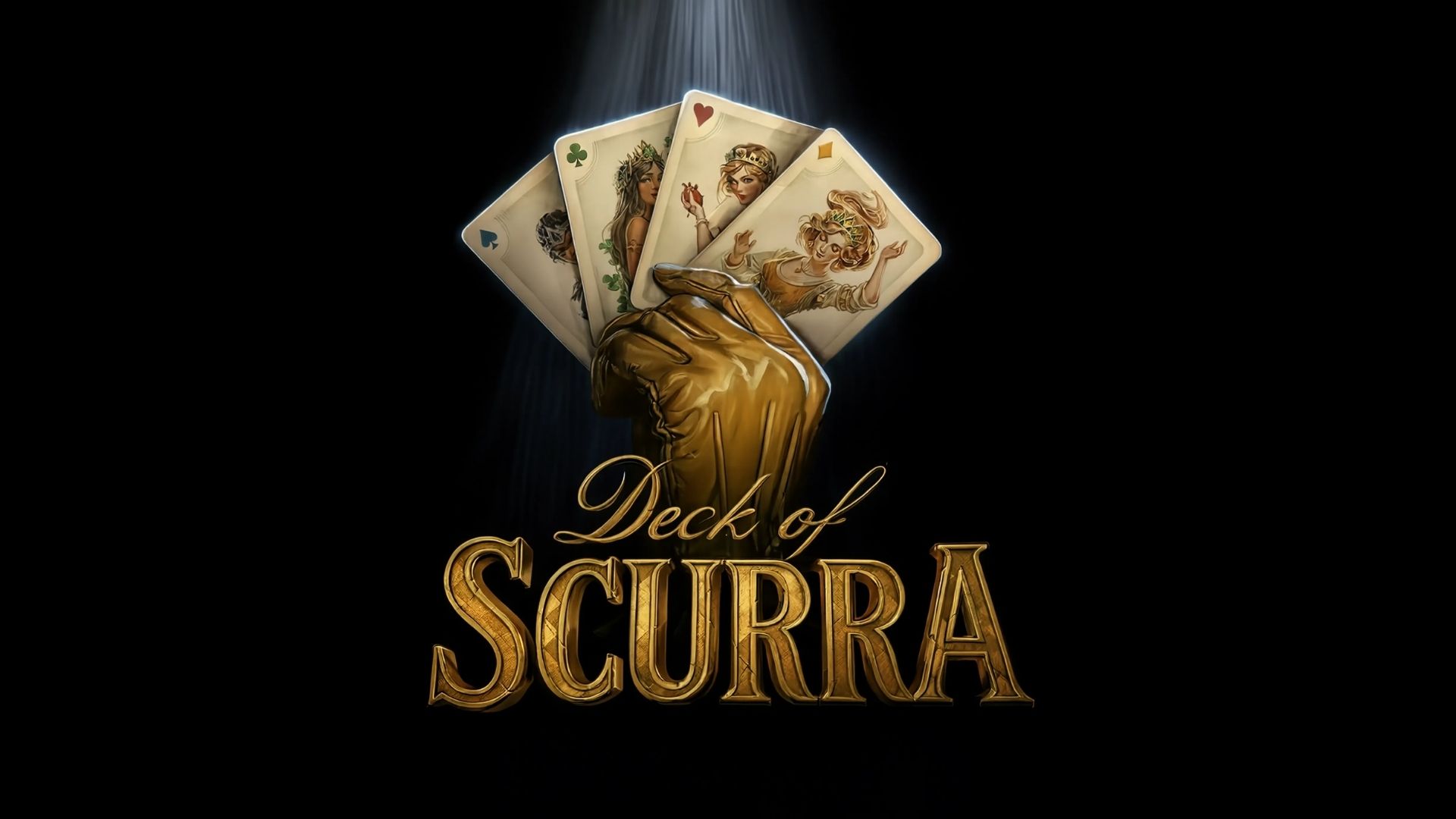
Deck of Scurra, released in November 2025, is what happens when that lesson gets applied from the first sketch rather than the third sequel. There is no minigame bolted on the side. The slot is the game. Fifteen cards land on a table in a 5x3 grid, wins pay across 243 ways, winning cards are swept away and replaced, and hidden among the replacements are Alteration Cards that rewrite the deck underneath you. The bonus does not change venue. It changes the rules of the deck you were already playing, and every change it makes is permanent for the rest of the round.
The result carries 60.9% of its return in the base game, the highest we have measured from this studio, and it is the best-looking thing they have made. It also ships in three configurable RTP builds, the lowest of which returns 86.10%, and the way that cut is concealed is the most instructive thing in this review. For the wider catalogue of games we have priced this way, see our slot reviews.
Deck of Scurra specification
Figure 1. Published by Print Studios and compiled from independent listings, using the 96.09% build throughout.
The symbol pays are the first thing that should catch your eye, and they look wrong until you understand the game. Five of a kind on the low cards pays 1x the bet. Five of a kind on the four Queens pays 5x. In a 10-line game those numbers would be an insult. Here they are a design decision: with 243 ways, cascades that chain, and Alteration Cards that duplicate and upgrade symbols mid-sequence, a single spin can resolve into dozens of simultaneous ways. The paytable is small because the multiplication happens elsewhere.
The other number worth pausing on is the hit frequency of 24.63%, roughly one winning spin in four. That is high for a game rated 9 out of 10 on volatility, and it is only possible because a "hit" here means an entire cascade sequence rather than a single line.
Where the return sits, and how the low build hides its cut
Run the standard decomposition. An average bonus win of 78.72x arriving once every 209.57 spins contributes 78.72 divided by 209.57, which is 0.3756, or 37.56 percentage points. Subtract from 96.09 and the base game holds 58.53.
Where each €100 you stake comes back from
96.09% build. Bar width is proportional to each share.
Figure 2. Read it as a destination map for your stake, not a promise about any one session. Bonus share is computed from the published figures; the base game share is the remainder.
What that bar is telling you. Over a long run of spins, for every €100 you put through this game, about €58.53 comes back through ordinary spins and cascades, about €37.56 comes back through the bonus rounds you happen to trigger, and €3.91 stays with the casino. The three shares always sum to €100 because they account for the entire stake. This is a long-run average across millions of spins, not a description of your evening: a single session can return nothing at all, or several hundred times the stake.
The useful part is the ratio between the first two blocks. 60.9% of everything this game gives back arrives during normal play rather than inside a feature, which is the highest figure we have measured from Print Studios and continues a trend that is now unmistakable across their catalogue.
Share of total return delivered by the base game
Figure 3. Derived from each game's published average bonus win and bonus frequency. Pine of Plinko also has 12 points removed for its Dream Drop jackpot contribution.
A higher bar does not mean a better game, and it does not mean more money. This chart says nothing about how much any of these games pay back. That is the RTP, and on RTP Deck of Scurra's 96.09% actually sits below Pine of Plinko 2's 96.32%. What the chart measures is where the money is distributed, not how much of it there is. A game can have a tiny base share and a high RTP, or a large base share and a mediocre one.
What it does tell you is how a session will feel and where your money is best spent. Read it like this:
Low base share, under about 30%
- Base spins are structurally poor value, returning roughly 20 cents on the euro in the two Pine games
- The bonus is where nearly all the return lives, so reaching it is the entire point
- Feature buys and boosts make mathematical sense, since skipping the base game raises your average return
- Long dry stretches are not bad luck, they are the design working as intended
High base share, over about 55%
- Ordinary spins carry most of the return, so base play is genuinely worth sitting through
- The bonus is a highlight rather than the whole product
- Buying the feature still nudges RTP up, but it skips a part of the game that is actually paying you
- Sessions feel steadier, which is a comfort factor and also a reason they run longer
So the honest reading of Figure 3 is not that Deck of Scurra pays more than Pine of Plinko 2. It is that in Pine of Plinko 2 you are mostly paying to wait, and the maths quietly tells you to buy your way past the waiting. In Deck of Scurra you are not, and the game between bonuses is worth your attention on its own terms. Neither is better value in absolute terms. They ask for a different way of playing.
Before the chart, the formula, because the number underneath it is easy to misread. Bonus share is the average bonus win divided by how often the bonus arrives, all divided by the game's RTP. Base share is whatever is left:
Base share = (RTP − average bonus win ÷ bonus frequency) ÷ RTP
For Deck of Scurra that is (96.09 − 78.72 ÷ 209.57) ÷ 96.09, which gives 60.9%.
Now the part that matters to your wallet. Print Studios publishes the full math model for its reduced builds, which almost no studio does, and comparing them shows exactly where a 10-point RTP cut goes.
96.09% build against the 86.10% build
Figure 4. Both math models published by Print Studios. The 9.99 point cut is applied proportionally across the model while the bonus round's own value is held constant.
There is one shortcut worth knowing. The 86.10% build ships without feature buy options. If you open the menu and there is no Feature Buy panel, that absence is itself the tell. It takes a second, it needs no arithmetic, and it is the single most useful thing in this review.
The cost is not small. On the top build a €100 turnover carries an expected loss of €3.91. On the 86.10% build the same session costs €13.90, which is 3.55 times as much for identical play. Print Studios deserves credit for publishing the numbers that make that comparison possible. The operator choosing the low build does not.
Alteration Cards and the deck that changes underneath you
Every win triggers a cascade. Winning cards are swept from the table and new ones are dealt into the gaps, and the sequence repeats while wins keep landing. That much is standard. What is not standard is what arrives in those gaps.
The five Alteration Cards
Figure 5. Five alteration types across three families. Print Studios does not publish individual trigger rates or values, so the ordering and commentary are our reading of the mechanics.
The Crow Cards deserve the arithmetic. On a 5x3 grid with 243 ways, the ways count is the product of symbol counts across the five reels, so three symbols on every reel gives 3 to the power of 5, which is 243. Add a symbol to one reel and you do not add ways, you multiply them. That is why a duplication effect in a ways game is worth considerably more than the same effect in a payline game, and why the base pays can afford to be as low as 1x.
The Evolving Deck Bonus, where the alterations stick
Three, four or five Jester Cards open the bonus. Every round begins with a deck upgrade, and from there the crucial rule applies: every alteration you collect is permanent for the remainder of the round. Each Jester that lands during the feature adds an extra spin. The studio's own figure is that up to 12 symbol cards and 9 alteration cards can end up working in your favour by the end.
That single rule changes the shape of the round completely, and it is the same structural idea we identified in Extra Chilli's persistent multiplier, executed on a deck instead of a number.
The value of a free spin rises with its index. Spin two is played on a nearly unmodified deck. Spin fourteen is played on a deck that has been upgraded, re-suited and duplicated a dozen times. This has two practical consequences. Extra spins from Jesters landing late are worth far more than the same spins landing early, and a round that ends quickly is not a small version of a big round, it is a fundamentally different distribution.
It also explains why the studio can publish a 9 out of 10 volatility rating alongside a 24.63% hit frequency without contradiction. The base game is busy. The bonus is where the variance lives, and the compounding deck is why.
From the insider files
Every slot review we publish, with the maths shown→ Shuffle: terms, withdrawals and what the bonus really costs→ Inside the on-chain PvP casino model→Six ways in, and every paid one beats spinning
Print Studios publishes an RTP for each route into the bonus, which lets us price the whole menu.
House edge per 100 staked, by route
Figure 6. Bars scaled to the base game edge so the differences are visible. The total spread across all six routes is 0.37 percentage points.
This is the third Print Studios game in a row where every paid route returns more than not paying, and the reason is always the same: the base game is the lowest-returning part of the model, so anything that reduces your exposure to it lifts your average. The spread here is 0.37 points, worth 37 cents per €100 staked. That is a rounding error you happen to be on the right side of, not a strategy.
Two of the routes are genuinely novel and worth describing properly.
The Adjustable Scatter Boost is a slider, not a switch. It moves your scatter chance continuously from 0.66% up to 97.05%, with the cost rising alongside, starting at 1.5x the bet. At the top of the range you are effectively buying the bonus by another name. Most games give you two or three discrete options. Building a continuous dial between "slightly better odds" and "near certainty" is a design idea nobody else is shipping, and it collapses the artificial distinction between an ante bet and a feature buy.
The Mystery Evolving Deck Bonus costs 150x and delivers 3, 4 or 5 Jester Cards with probabilities of 60%, 30% and 10%, for an expected 3.5 Jesters. At its published 96.33% RTP, 150 multiplied by 0.9633 gives an expected return of 144.50x, which is 1.84 times the 78.72x average of a naturally triggered round. That ratio is the honest way to read the price: you are not paying 150x for a normal bonus, you are paying it for one that is on average almost twice as large.
How long the bonus takes, and what 20,000x really means
Spins required at the published 1 in 209.57 trigger rate
Figure 7. Geometric distribution applied to the published rate. Bars scale to the 99% figure.
481 spins for a 90% chance is a long wait, and it is the single strongest argument against this game. At the €0.10 minimum that is €48.10 of turnover, most of which cycles back through a base game hitting once every four spins, but the bonus itself is a genuinely rare event.
The maximum win is rarer still. At 1 in 4,814,636 spins, that is one per 22,974 bonus rounds. Reaching a coin-flip chance would take about 3.34 million spins, roughly €334,000 of turnover at the minimum stake, carrying an expected loss near €13,000. And 20,000x is €2,000 at the €0.10 minimum or €1,000,000 at the €50 maximum, so the ceiling means something entirely different depending on where you sit on the bet slider.
Against the Plinko trilogy
| Title | RTP | Max win | Bonus rate | Avg bonus | Base share |
|---|---|---|---|---|---|
| Deck of Scurra | 96.09% | 20,000x | 1 in 210 | 78.72x | 60.9% |
| Pond of Plinko | 96.10% to 96.49% | 30,000x | 1 in 233 | 96.16x | 57.2% |
| Pine of Plinko 2 | 96.32% | 20,000x | 1 in 117 | 88.71x | 21.3% |
| Pine of Plinko | 93.48% | 10,000x | 1 in 126 | 76.58x | 22.1% |
Read down the base share column and you are reading the studio's development history. The first two games kept roughly four fifths of their return behind a feature. Pond of Plinko fixed it by bolting a 10,000x prize onto the base game. Deck of Scurra did not need to bolt anything on, because the base game was designed to carry the weight from the start.
On headline RTP, Pine of Plinko 2 at 96.32% and Pond of Plinko's top build at 96.49% both beat Deck of Scurra's 96.09%. On max win, Pond of Plinko's 30,000x is the biggest in the catalogue. Deck of Scurra does not win this table on any single number. It wins on the thing the table cannot show: it is the only one of the four where the game you play between bonuses is genuinely interesting on its own terms.
The verdict
Scorecard
Figure 8. Five criteria scoring 10, 10, 9, 9 and 8, summing to 46 for an average of 9.2 out of 10.
Design, 10. A secret parlour at the turn of the century, cards that behave like objects rather than sprites, and a jester whose presence on the artwork turns out not to be decoration. Print Studios has always been strong here, and this is their best work.
Feature depth, 10. Five Alteration Card types across three families, permanent upgrades compounding through the bonus, a continuous scatter dial and four buy tiers. Very few games this year have this much genuinely interacting machinery.
Player engagement, 9. The evolving deck gives you a state to track and something being built rather than a number going up. Short of a 10 only because nothing you do inside the round changes it; the engagement is in watching the deck grow, not steering it.
Value for money, 9. 96.09% is respectable, every paid route improves on it, and the studio publishes enough to verify all of it. The 86.10% build sitting in the wild is what keeps this off a 10.
Session pacing, 8. 481 spins for a 90% chance of the bonus, on a model rated 9 out of 10 for volatility. The base game carries the session better than any previous Print Studios title, and it is still a long wait.
Who it is for, who should skip it
Play it if
- You want a slot where the base game is the game, not a queue for the bonus
- Cascading, ways-based maths and compounding modifiers appeal to you
- Atmosphere matters as much as mechanics in how you pick games
- You can verify your operator runs the 96.09% build
- You buy features deliberately, with a set count and a stop point
Skip it if
- Your casino hides the RTP line or ships the game without feature buys
- You want frequent bonus rounds, since 1 in 210 is rare for this genre
- Layered mechanics annoy you and you want to press spin without learning rules
- A 9 out of 10 volatility rating reads as a warning rather than an invitation
- You are chasing 20,000x, which sits at 1 in 4.8 million spins
Responsible play, specific to this design
A high score is not an argument for playing harder. Three risks come from this build in particular.
A base game this good is a longer session. Everything praised above has a second effect: a game that pays something one spin in four and constantly shows you cards transforming is far easier to sit in front of than one that pays 18% of the time. The edge is still 3.91 points on the best build. A more absorbing way to lose the same money is still losing the same money, and absorption is measured in time and turnover.
The permanent deck creates a sunk-cost feeling that is not real. Watching a deck you have spent fourteen spins building makes stopping feel like abandoning progress. The deck resets at the end of the round regardless, and the next round starts from scratch whether you play it now or never. Nothing carries over between bonuses.
The Adjustable Scatter Boost is a slider, which is the problem. A dial that runs continuously from 1.5x the bet up to near-certain triggering has no natural stopping point, and each increment feels small next to the last. Decide the setting and the number of spins before you open the menu.
If any of this is describing something that has stopped feeling like a choice, our guide on recognising and stopping gambling addiction is written for exactly that moment. And if the objection is structural rather than personal, the house edge in a slot is fixed by the studio and the operator and no amount of play changes it, which is why on-chain PvP formats have drawn the players who want their decisions to matter.
Keep reading
Frequently asked questions
What is the RTP of Deck of Scurra?
How can you tell if you are on a low RTP version of Deck of Scurra?
What is the max win on Deck of Scurra?
How do Alteration Cards work in Deck of Scurra?
What is the Evolving Deck Bonus?
How often does the Deck of Scurra bonus trigger?
Is the Deck of Scurra bonus buy worth it?
How does Deck of Scurra compare to the Print Studios Plinko games?
Nothing here is financial or gambling advice. If gambling is affecting your life, contact a support service in your jurisdiction.