
The short answer

Pine of Plinko is a Print Studios ball-dropper wrapped around a 5x3 slot, wired into Relax Gaming's Dream Drop jackpot network. Print Studios publishes an unusually complete set of numbers for it, and those numbers let you do something rare: work out exactly where every cent of the return goes.

  1. 93.48% RTP, which is low. The house edge is 6.52%, against 3.61% on a standard 96.4% game. That is 1.8 times worse per unit staked.
  2. Two thirds of all return is locked inside a bonus you see once every 126 spins. The Plinko Bonus carries 60.78 of the 93.48 points. The base game returns about 20.7.
  3. 12 points go to the Dream Drop jackpot network, funding five tiers from a €1 Rapid to a Mega that averages roughly €2.5 million.
  4. Bet Boost is a trade, not an upgrade. It doubles how often the bonus arrives and roughly halves what the bonus is worth against your stake. Net RTP gain: 0.31 points.
  5. The sequel settles the argument. Pine of Plinko 2 dropped the jackpot and returns 96.32% with double the max win. Same studio, same bonus, 2.84 more points.

Analysis based on Print Studios' published math model for game ID pineofplinkodd, written 28 August 2026. Original release 31 January 2023. Jackpot seed and must-drop values reflect the Dream Drop network at time of writing and move constantly.

Plinko is older than almost everything else on a casino lobby page. Drop a ball down a pegboard, watch it clatter through a lattice of pins, collect whatever bucket catches it. The physics does the work and the maths hides behind the spectacle, which is precisely why the format survived from a 1983 television studio into a crypto casino's instant-games tab without changing shape.

Print Studios' contribution is to bolt that pegboard onto a slot. Pine of Plinko runs a plain 5x3 grid with 10 fixed lines whose only real job is producing scatters, and when three land you leave the reels entirely and start dropping balls. Hit the bumpers in the middle of the board and the game escalates, adding drops and doubling the number of balls that fall with each one, up to a final stage that releases 256 balls at a time. There is a second version of the game wired into Relax Gaming's Dream Drop jackpot network, and that is the version Print Studios currently serves from its own site.

What follows is a full accounting. Where the 93.48% actually goes, what the ball-doubling ladder is worth, what Bet Boost really trades away, a tier-by-tier breakdown of the Dream Drop jackpot, and why the sequel is the strongest argument against this version of the game. For contrast throughout, we will use the Extra Chilli More Chilli analysis, because that game hides its numbers where this one publishes them.

Pine of Plinko specification

StudioPrint Studios
Game IDpineofplinkodd
Release31 January 2023
Grid5x3, 10 fixed lines
RTP93.48%
RTP with Bet Boost93.79%
Jackpot contribution12% of every bet
Volatility4 out of 5
Max win10,000x
Max win probability1 in 8,400,000
Hit frequency18.36%, or 1 in 5.45
Bonus frequency1 in 126
Bonus with Bet Boost1 in 60
Average bonus win76.58x
Ball prize range0.1x to 1,000x per ball
Bet range€0.20 to €100, default €1

Figure 1. Published by Print Studios. The completeness of this list is itself notable, and Section 02 explains why.

Start with what is not on most spec sheets. Print Studios publishes hit frequency, bonus frequency, average bonus win and the probability of the maximum win. Big Time Gaming publishes none of those four for Extra Chilli More Chilli. Pragmatic publishes none of them for Gates of Olympus POP. Almost nobody in this industry tells you how often the feature arrives or what it is worth when it does.

That transparency is worth saying out loud before the criticism starts, because everything unflattering below is derived from figures the studio chose to release. A studio running a 93.48% game and publishing the numbers that expose it is behaving better than a studio running a 96.4% game and publishing nothing.

One inconsistency to flag. Print Studios' own game page lists a release date of 31 January 2023 and a headline RTP of 93.48%, but the demo it serves runs game ID pineofplinkodd, the Dream Drop build. The original 2023 release and the jackpot version are not the same product, and the page presents them as one. If an operator lists a Pine of Plinko without the five jackpot meters, its RTP will not be 93.48%, and you should check the paytable rather than assume.

Where the 93.48% actually goes

Here is the arithmetic that makes this game worth writing about. An average bonus win of 76.58x arriving once every 126 spins contributes 76.58 divided by 126, which is 0.6078, or 60.78 percentage points of return. The jackpot contribution is a published 12 points. Subtract both from 93.48 and the base game is left holding 20.70.

Every €100 you stake, split by where it ends up

20.70 60.78 12.00 6.52
Base game lines Plinko Bonus Dream Drop pool House edge

Figure 2. Bonus and jackpot shares are computed from published figures. The base game share is the remainder, so it carries whatever rounding the published numbers contain.

Three things fall out of that split, and each one changes how you should read the game.

Sixty-five percent of everything this game returns is inside a feature you reach once every 126 spins. A session that does not hit the bonus is not an unlucky version of the game. It is a different game, one that returns roughly 21 cents on the euro. Volatility ratings describe how bumpy the ride is. This number describes something else entirely: how much of the ride you are not on.

The base game is a scatter delivery mechanism and nothing more. A hit frequency of 18.36% against 20.70 points of return means the average base-game hit pays about 1.13 times the stake. That is not bad for a 10-line game, but there are only 10 lines and they hit once every 5.45 spins, so the base game's job is to look like a slot while it waits for three scatters.

The 12 points routed to the jackpot are real money leaving your session. They come back to players, just not necessarily to you and not on any timescale you control. Section 05 breaks that pool down tier by tier, and it is the part of this game that deserves the most scrutiny.

This is the lowest RTP we have analysed and the most honest spec sheet we have been given. Those two facts are connected. Print Studios published enough numbers for anyone to work out exactly where the 6.52% goes, which is more than the studios charging you less are willing to do.Crypto Casino Insiders

The Plinko Bonus and the ball-doubling ladder

Three or more scatters end the slot and open the pegboard. You get a number of drops, you release them at your own pace, and each ball settles into a prize bucket worth between 0.1x and 1,000x. Three bumpers sit in the middle of the board, and hitting them unlocks the next stage.

How a bonus round escalates

1 Entry Three or more scatters open the board. You start with a modest allocation of drops and a single ball falling on each one. 1 ball per drop
2 Bumper unlock Balls that strike the three central bumpers advance the stage. Each advance adds 10 drops and doubles the balls released on every subsequent drop. +10 drops, balls x2
3 Final stage The ladder tops out at 256 balls falling on a single drop. At this point the 10,000x ceiling is the binding constraint, not the board. 256 balls per drop

Figure 3. Stage structure from Print Studios' published description. The number of stages follows from the doubling: reaching 256 balls from one requires eight doublings.

The doubling is the whole feature, and it compounds in a way that is easy to underestimate. Ten extra drops at stage one is ten extra balls. Ten extra drops at stage nine is 2,560 balls. Cumulatively, a round that runs the full ladder releases 5,110 balls.

Cumulative balls released by stage reached

Stage 110
Stage 370
Stage 5310
Stage 71,270
Stage 95,110

Figure 4. Bar length is log-scaled, because a linear scale would render stage one invisible. Counts assume 10 drops per stage and a ball count doubling from one.

What is a ball worth? The board is readable from any screenshot of the bonus. Fifteen buckets run symmetrically outward from the centre, paying 0.1x across the three middle slots and rising through 0.5x, 1x, 5x, 10x and 100x to a 1,000x bucket at each outer edge. Fifteen buckets means fourteen rows of pegs, and a ball bouncing left or right at each row follows a binomial distribution across 16,384 possible paths.

Weight each bucket by how many of those paths reach it and the expected value of a single ball comes out at 0.9282x the bet. The shape behind that average is the important part:

Roughly 57.6% of balls land in one of the three 0.1x buckets at the centre, because the centre is where the binomial piles up. Only 17.96% of balls pay 1x or better. A 100x bucket arrives about once in 546 balls, and a 1,000x edge bucket once in 8,192. The overwhelming majority of what you watch fall is worth a tenth of your stake.

That figure closes the loop on the published average. A mean bonus of 76.58x divided by 0.9282x per ball implies the average round releases about 82.5 balls, which sits between stage three at 70 cumulative balls and stage four at 150. The model and the studio's published number agree, which is a good sign that the board is being read correctly.

The mean is not the median, and here the gap is enormous. A distribution containing 1,000x buckets and 5,110-ball rounds has a mean dragged far above its typical outcome. Most bonus rounds end at stage one or two, worth about 9.3x and 27.8x respectively on these averages. The 76.58x figure exists because a small number of rounds run the ladder.

One correction worth making to the obvious assumption. It is tempting to conclude that reaching the final stage and hitting the maximum win are the same event, but the arithmetic says otherwise. A full 5,110-ball round averages 4,743x, less than half the 10,000x ceiling, and a single 256-ball drop averages 238x. Reaching stage nine is necessary for a max win and nowhere near sufficient. You need the ladder and a run of edge buckets, which is what a probability of 1 in 8.4 million spins, or one in roughly 66,667 bonus rounds, actually describes.

How often the bonus arrives, and what Bet Boost really does

A bonus frequency of 1 in 126 is a published figure, not an estimate, which means the waiting time can be computed exactly rather than modelled.

Spins required: standard / with Bet Boost

50%87 / 41
75%174 / 82
90%289 / 137
95%376 / 178
99%578 / 274

Figure 5. Geometric distribution applied to the published 1 in 126 and 1 in 60 trigger rates. Bars scale to the 99% figure.

Roughly 87 spins for a coin-flip chance of one bonus, and 289 spins before you are 90% likely to have seen one. At the €0.20 minimum that is €57.80 of turnover for the 90% mark, most of which cycles back through base-game hits. At the €1 default it is €289.

Now the interesting part. Bet Boost raises the bonus rate from 1 in 126 to 1 in 60, which is 2.1 times more often, and lifts RTP from 93.48% to 93.79%. Print Studios does not publish what the average bonus win becomes under Bet Boost, but it can be derived.

The jackpot takes 12% of whatever you stake, boosted or not. If the base game's share of stake is unchanged at 20.70 points, then the boosted RTP of 93.79 leaves 61.09 points for the bonus. Spread across a 1 in 60 trigger rate, that implies an average bonus win of 36.65x your total stake, against 76.58x unboosted.

Bet Boost roughly doubles how often the bonus arrives and roughly halves what it is worth relative to what you paid. Multiply 2.1 by 0.479 and you get 1.005. The two effects almost exactly cancel, which is precisely what a 0.31 point RTP gain looks like. Vary the base-game assumption between 18 and 23 points and the boosted average moves only between 38.3x and 35.3x, so the conclusion holds across any reasonable reading.

That is not a criticism of the feature. It is an accurate description of it. Bet Boost is a variance dial, not a value button. It buys you more frequent, smaller feature rounds for a marginally better return, which is a legitimate thing to want if you find 289-spin dry stretches unpleasant. What it is not is a way to make the game pay more.

The Dream Drop jackpot, tier by tier

Dream Drop is Relax Gaming's network progressive, launched in 2022 and running across dozens of titles from Relax and its partner studios, Print Studios among them. Pine of Plinko contributes to it and can win from it, which is the entire reason this version of the game exists.

The implementation here is specific and worth describing precisely. The jackpot bonus gives you an endless supply of drops. Every ball that falls advances one of five jackpot meters. Whichever meter fills first pays out that jackpot, and the round ends. There is no skill in it and no decision to make, but the design creates a genuinely tense object: a Mega meter sitting one ball from full, with four other meters racing it.

The five Dream Drop tiers

1RapidThe bottom tier and the one nearly every jackpot winner receives. Across the network it drops constantly, often within the same minute. Treat it as the realistic outcome of the jackpot feature rather than a consolation.Seeds at €1
2MidiA small step up, also dropping very frequently network-wide. Rapid and Midi together account for the overwhelming majority of Dream Drop wins ever paid.Seeds at €5
3MaxiThe first tier worth interrupting your session for. Still resolves regularly across the network, and the first point at which the payout exceeds what a decent Plinko Bonus would have given you anyway.Seeds at €100
4MajorCarries a must-drop ceiling, so it cannot grow indefinitely. Published accounts put the seed around €25,000 with a guaranteed drop before roughly €50,000, meaning the true value depends on how full the meter is when you arrive.Seeds around €25,000
5MegaThe headline. Also must-drop, with a ceiling that ratchets upward after each payout, and an average win reported at roughly €2.5 million. It resolves on the order of months across the entire network, not per game and certainly not per player.Seeds at €500,000 or higher

Figure 6. Seed and ceiling values are network parameters that change after every payout and vary by published source. Verify current values in the game's jackpot panel rather than trusting any static list, this one included.

The must-drop mechanic is the genuinely good idea here. A traditional progressive can grow forever, which means its advertised value tells you nothing about when it will pay. Dream Drop's Major and Mega tiers carry a ceiling they cannot exceed, and the winning point is drawn randomly inside that range. It converts an open-ended promise into a bounded one, and that is a real improvement on the format.

Now the cost. At the €0.20 minimum stake, 12% is 2.4 cents per spin flowing out of your session and into the network pool. To fund a single €500,000 Mega seed at that rate on your own would take roughly 20.8 million spins. You are not buying a jackpot. You are buying a fractional, bet-weighted share of a lottery whose realistic outcome is a €1 Rapid.

The contribution is proportional to stake, so the expected value you get back is proportional too, and the RTP does not change with bet size. What changes is the shape. A €0.20 player and a €100 player face the same 12% levy, but the €100 player's chance of the Mega is 500 times larger. The jackpot is not unfair to small stakes, it is simply irrelevant to them, and the game's presentation does not distinguish between those two things.

There is a structural echo here worth noting. A network jackpot is a pooled liquidity mechanism where many participants fund a prize that one of them collects, with the operator setting the parameters and publishing very little. That is the same shape as a lot of what happens in GambleFi pool design, and the comparison is not flattering to the slot: on-chain pools generally publish their contribution rates and payout logic on a block explorer. Dream Drop's parameters are documented across scattered affiliate pages that disagree with one another, which is how we ended up flagging the seed values in Figure 6. The transparency comparison we ran on on-chain casino models covers where that difference actually bites.

The sequel settles the argument

Print Studios released Pine of Plinko 2 in December 2023, and it is the cleanest natural experiment this format has produced. Same studio, same pegboard, same 5x3 grid with 10 lines, same bumper escalation up to 256 balls. One difference: no Dream Drop jackpot.

Pine of Plinko against its sequel and two recent benchmarks
TitleRTPMax winBonus rateAvg bonusStatus
Pine of Plinko (Dream Drop)93.48%10,000x, 1 in 8.4m1 in 12676.58xJackpot version
Pine of Plinko 296.32%20,000x, 1 in 28m1 in 11788.71xNo jackpot
Extra Chilli More Chilli96.39%30,000x, not publishedNot publishedNot publishedLive since Sep 2026
Gates of Olympus POP96.56%25,000x, not publishedNot publishedNot publishedRecently launched

Run the same decomposition on the sequel. An 88.71x average bonus at 1 in 117 contributes 75.82 points. Subtract that from 96.32 and the sequel's base game is left with 20.50 points.

Pine of Plinko's base game returns 20.70 points. The sequel's returns 20.50. Within rounding, they are the same game underneath. The entire difference between a 93.48% product and a 96.32% product is what happens to the money above that base: the original routes 12 points into a network jackpot and pays 60.78 through the bonus, while the sequel routes nothing to a jackpot and pays 75.82 through the bonus.

That decomposition is the most useful thing in this article, so it is worth stating plainly. You can play essentially the same Plinko game with the jackpot or without it. Without it, you keep 2.84 more points of return, the bonus arrives slightly more often, the average bonus is 16% larger, and the ceiling doubles to 20,000x.

The original wins on exactly one measure. Its 10,000x maximum sits at 1 in 8.4 million against the sequel's 20,000x at 1 in 28 million, so the top prize here is 3.3 times more reachable. If you specifically want a shot at a capped max win, and you are indifferent to two and a half points of RTP, that is a defensible preference. It is also the only version of the preference that survives the arithmetic.

The 10,000x ceiling, in real numbers

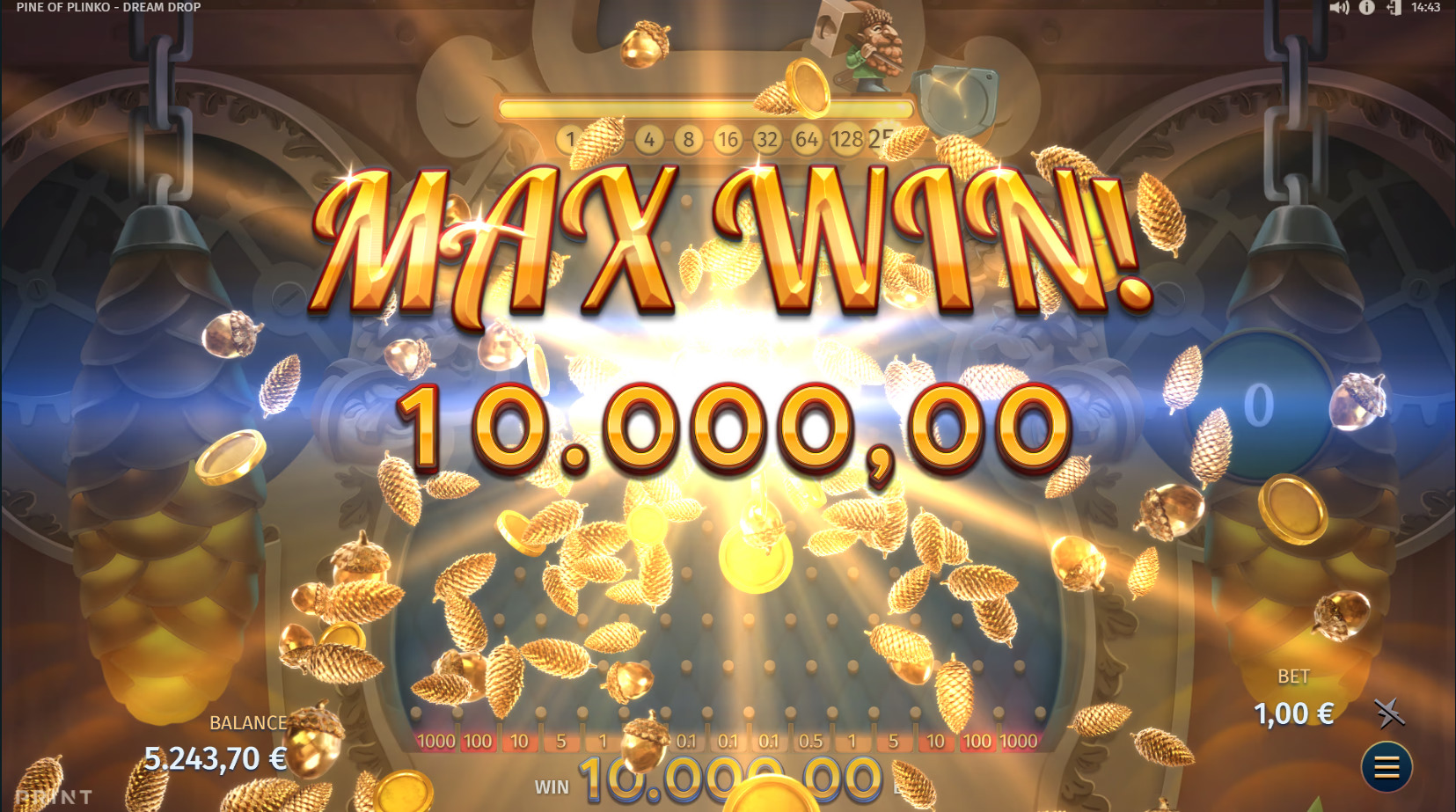
Pine of Plinko max win screen showing a 10,000x payout of 10,000.00 euro from a 1.00 euro bet in the Print Studios Dream Drop slot, with the stage meter reading 1 to 256 and the Plinko bucket strip from 0.1x to 1000x visible below

Figure 8. The 10,000x maximum paid in full: 10,000.00 on a 1.00 stake. Two details are worth noting beyond the headline. The stage meter along the top runs 1, 2, 4, 8, 16, 32, 64, 128, 256, confirming the nine-stage ball ladder in Figure 4. The bucket strip along the bottom shows the 1,000x slots at each outer edge and the 0.1x cluster in the middle, which is the distribution priced in Section 03.

Print Studios publishes the max win probability, which almost nobody does, so this section can be arithmetic rather than speculation.

At 1 in 8.4 million spins, reaching a coin-flip chance of the maximum takes roughly 5.8 million spins. At the €0.20 minimum that is about €1.16 million of turnover, carrying an expected loss of roughly €76,000 at the 6.52% house edge. The number is not a warning, it is a definition: a 1-in-8.4-million event is not something a bankroll pursues, it is something that happens to someone.

The more useful framing is what 10,000x is worth to you specifically. At the €0.20 minimum it is €2,000. At the €100 maximum it is €1,000,000. Which means that for a small-stakes player the Dream Drop Mega, averaging around €2.5 million, is a far bigger prize than the game's own maximum win, while for a maximum-stakes player the two are roughly comparable.

That inversion is the clearest way to understand who this version is built for. If you play at €0.20, the jackpot is the only route to a life-changing number and you are paying 12% of every spin for a bet-weighted share so small it barely registers. If you play at €100, the base game's own ceiling gets you to seven figures and the jackpot is a bonus lottery on top. The version of the game that makes sense at €100 does not make sense at €0.20, and nothing in the interface says so.

Where to play it

Pine of Plinko at 1win

1win carries the Print Studios catalogue including both Pine of Plinko builds, takes crypto deposits, and runs the Dream Drop network games. Before you spin, open the information panel and confirm two things: that the RTP line reads 93.48%, and that the five jackpot meters are actually displayed. If the meters are missing you are on the non-jackpot build, which is a different game with different maths. Our full assessment of the operator, including withdrawal terms and how bonus wagering interacts with jackpot games, is linked below the button.

Play Pine of Plinko at 1win

Affiliate link. We earn a commission if you sign up through it, at no cost to you. It does not change the 93.48% figure or anything else in this analysis. Read the full 1win review before depositing. 18+, play responsibly.

Who it is for, who should skip it

Play it if

  • You want a shot at the Dream Drop Mega and accept 12% of every spin as its price
  • You play at stakes where 10,000x alone would not change your life
  • The pegboard itself is the appeal, and the slot around it is incidental
  • You value a studio that publishes its bonus frequency and max win odds
  • You want the more reachable of the two ceilings in the series

Skip it if

  • You are playing for the Plinko bonus, since the sequel does it better for 2.84 more points
  • A 6.52% house edge is more than you want to pay for a theme
  • You expect Bet Boost to increase what you win rather than how often
  • Long dry stretches bother you, since 90% confidence of a bonus takes 289 spins
  • You are at the €0.20 minimum, where the jackpot is a levy more than an opportunity

Scorecard

Bonus design8
Base game3
Jackpot value5
Return for money3
Transparency9
Watchability8

Figure 7. Scored on the published math model. Transparency scores high because Print Studios released the figures that produced every other score on this card.

Responsible play, specific to this design

Three risks come from this particular build rather than from slots in general.

A near-full jackpot meter is the most dangerous object in the game. Print Studios describes the peak of the experience as a big meter sitting one ball from triggering, and that is an accurate piece of design writing. It is also a textbook near-miss, engineered and displayed. A meter one ball from full does not mean you are close. Meters advance from network-wide play, and yours arriving late changes nothing about the probability.

The 18.36% hit frequency mostly returns less than the stake. Wins land once every 5.45 spins with a win animation and a rising counter, and the base game returns 20.70 points overall. Watch the balance, not the sound.

Bet Boost is the loss-chasing button here. There is no bonus buy in this version, so the boost is the only lever, and it presents as a way to reach the good part faster. It costs more per spin, so a fixed bankroll runs out in fewer spins, and it reduces the average size of the round you were reaching for. If you use it, decide the number of boosted spins before you start.

The wider point is that a 6.52% edge is set by the studio and the operator, and no amount of play changes it. That is a large part of why formats where you are not playing the house at all have drawn interest, and it is worth understanding the trade before deciding where a bankroll goes.

Frequently asked questions

What is the RTP of Pine of Plinko?
93.48%, rising to 93.79% with Bet Boost active. That is low. The house edge is 6.52%, against 3.61% on a typical 96.4% release, so every 100 units you stake carries an expected loss of 6.52 rather than 3.61. Note that 12 of those 93.48 points are the Dream Drop jackpot contribution rather than money returned through the game itself, which means the game you are actually playing returns 81.48 points and the rest depends on a network jackpot.
What is the max win on Pine of Plinko?
10,000x your bet, with a published probability of 1 in 8,400,000 spins. That works out to roughly one maximum win per 66,667 bonus rounds. Reaching a coin-flip chance of it would take about 5.8 million spins, which at the 0.20 minimum is around 1.16 million euro of turnover. Separately, the Dream Drop Mega jackpot is a cash amount rather than a multiplier, and at small stakes it is by far the larger of the two top prizes.
How often does the Pine of Plinko bonus trigger?
Once every 126 spins on average, or once every 60 spins with Bet Boost active. Using the geometric distribution, that means 87 spins for a 50% chance of seeing one bonus, 289 spins for a 90% chance, and 578 spins for a 99% chance. With Bet Boost those figures fall to 41, 137 and 274 spins.
Is Bet Boost worth it on Pine of Plinko?
It is a variance trade rather than a value increase. Bet Boost makes the bonus arrive 2.1 times more often and lifts RTP by 0.31 points, but the arithmetic implies the average bonus win falls from 76.58x to roughly 36.65x of your total stake. The two effects almost exactly cancel. Use it if you dislike long dry stretches and want smaller, more frequent rounds. Do not use it expecting the feature to pay more.
How does the Dream Drop jackpot work in Pine of Plinko?
The jackpot bonus gives you an endless supply of ball drops. Each ball that falls advances one of five jackpot meters, and whichever meter fills first awards that jackpot and ends the round. The five tiers are Rapid, Midi, Maxi, Major and Mega, seeded at roughly one euro, five euro, one hundred euro, twenty-five thousand euro and five hundred thousand euro or higher. Major and Mega carry must-drop ceilings they cannot exceed. Twelve percent of every bet placed funds the network pool.
How much of Pine of Plinko's return comes from the bonus?
About 65% of it. An average bonus win of 76.58x arriving once every 126 spins contributes 60.78 of the 93.48 points of total return. The Dream Drop jackpot takes 12 points, leaving roughly 20.70 points for base game line wins. In practical terms, a session that never reaches the bonus is playing a game that returns about 21 cents on the euro.
Is Pine of Plinko or Pine of Plinko 2 the better game?
On published figures the sequel wins almost everywhere. Pine of Plinko 2 returns 96.32% against 93.48%, doubles the ceiling to 20,000x, triggers slightly more often at 1 in 117, and pays a larger average bonus at 88.71x. Both games have an almost identical base game return of around 20.5 to 20.7 points, so the whole difference is that the original diverts 12 points into the Dream Drop network. The original wins on one measure only: its 10,000x maximum is 3.3 times more reachable than the sequel's 20,000x.
Where can you play Pine of Plinko?
Print Studios distributes through Relax Gaming, so the game appears in most major crypto casino lobbies, 1win among them. Two things are worth checking before you play. Confirm the information panel reads 93.48%, and confirm the five jackpot meters are visible, because the non-jackpot build of Pine of Plinko is a different product with different mathematics. Also check whether jackpot games are excluded from bonus wagering at your operator, since many exclude them entirely.

Specifications are taken from Print Studios' published material for game ID pineofplinkodd and from Relax Gaming Dream Drop network documentation. Jackpot seed and must-drop values change after every payout and are reported inconsistently across sources, so verify them in the game's own jackpot panel. Figures for base game return, boosted average bonus win and all waiting times are our calculations from published data, with assumptions stated in the relevant captions, and describe probability rather than outcome. This page contains an affiliate link. Nothing here is financial or gambling advice. If gambling is affecting your life, contact a support service in your jurisdiction.