


Stake's Football in the Sky: Inside the 10,000-Foot Marketing Play

The short answer
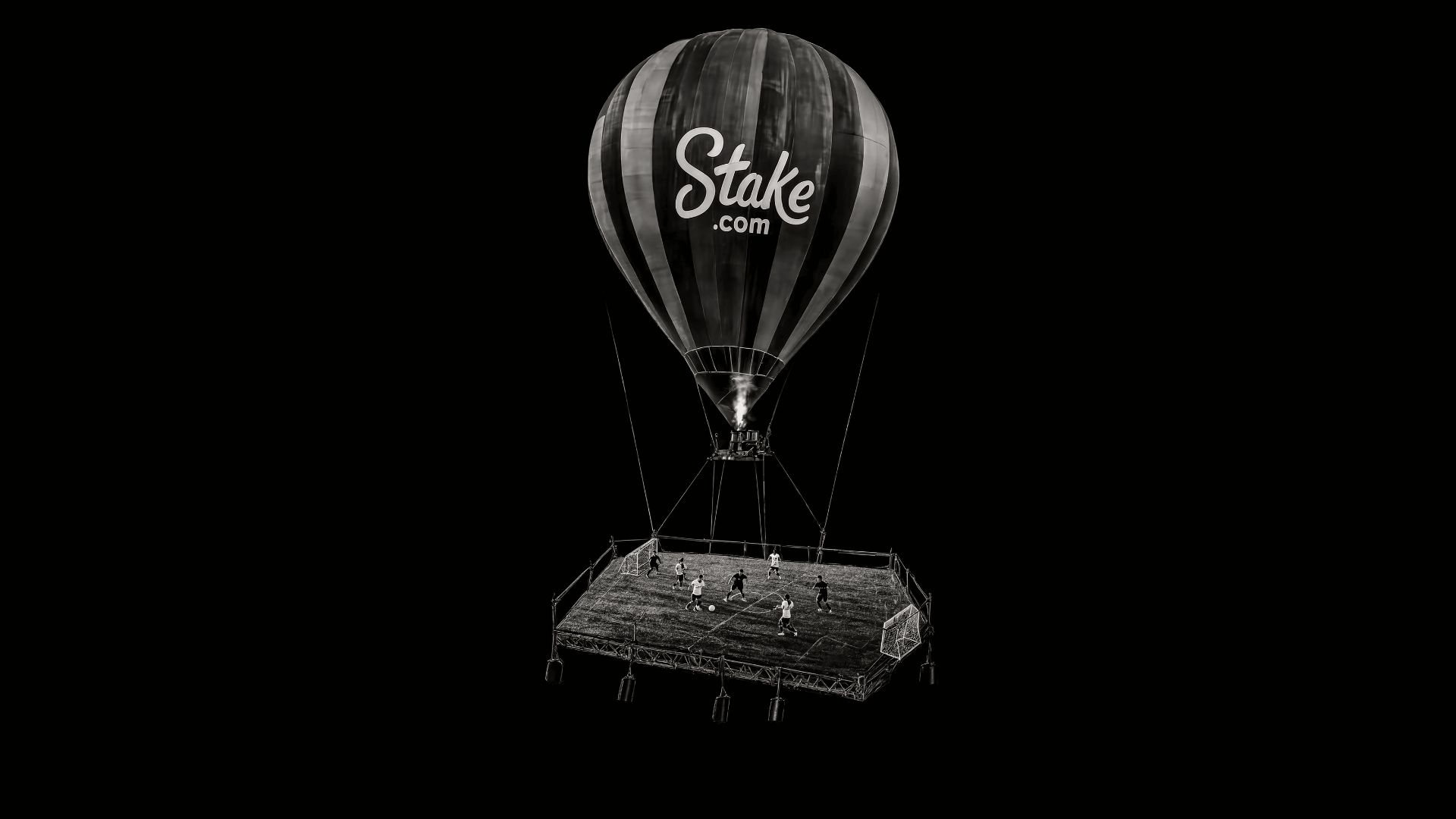
In June 2026, Stake staged the first-ever football match on a pitch suspended beneath a hot air balloon at 10,000 feet, the centerpiece of its It's All At Stake tournament campaign. Six extreme-sports creators played, then parachuted off. The stunt is a textbook case of branded entertainment: extreme-sports spectacle engineered to travel on social media without an obvious ad label, borrowing the exact playbook Red Bull used to build a multibillion-dollar brand.
| The stunt. A 12-by-20-metre, 3,000kg synthetic pitch flown by balloon for a 60-minute flight, with creators Nathan Roque, Alessio Papia, Nicolo Contrada, Yasmin Xavier, Sara Vidal, and Carol Chafauzer playing before exiting by parachute. | |
| The reach. Stake says the wider It's All At Stake campaign passed 200 million views across social and earned media in the tournament's first week. That figure is self-reported and measures reach, not conversion. | |
| The psychology. Extreme sports trigger physiological arousal in viewers, and through excitation transfer, some of that arousal attaches to the brand present in the moment. Red Bull's Stratos jump is the canonical example. | |
| The positioning. Stake is moving from static sponsorship (logos on F1 cars and jerseys) toward owned spectacle, treating marketing as content that audiences choose to watch rather than ads they're served. | |
| The context. Not every crypto casino stunt lands. Duel's shock-content strategy and Roobet's marketing controversies show how the same virality mechanics that drive reach can amplify reputational damage. |
A regulation-adjacent football pitch, twelve metres by twenty, built on a steel frame weighing three tonnes, hanging in open sky beneath a hot air balloon at 10,000 feet. Six content creators playing a small-sided match on synthetic grass with nothing but air below them, then stepping off the edge one by one under parachutes once the final whistle blew. This is not a metaphor for anything. Stake actually built it, actually flew it, and released the film on June 23, 2026 as the centerpiece of a campaign timed to this summer's biggest football tournament. To understand why a crypto casino would spend what this cost, you have to look past the spectacle to the mechanics underneath it.
The stunt isn't random. It's a precise application of a marketing strategy that has been refined over two decades, most famously by Red Bull, and it reflects a specific bet about how attention works in an era where conventional advertising has stopped landing. It also reflects where Stake is in its own evolution, from a scrappy crypto dice site into the largest online casino in the world, chasing the one thing its money still can't fully buy: legitimacy.
This piece breaks down the campaign itself, the psychology of why extreme-sports association works on the brain, the crypto casino guerrilla campaigns that succeeded and the ones that blew up, and the two-decade genesis of Stake that explains why it, specifically, keeps pushing marketing into spectacle.
The campaign: what Stake actually built
The activation is the latest entry in It's All At Stake, the global brand platform Stake launched ahead of this summer's international football tournament. An earlier film in the same campaign featured retired stars including Sergio Aguero, Patrice Evra, Iker Casillas, and Eden Hazard. The balloon match escalated from celebrity endorsement to physical spectacle.
The specifics matter because the specifics are the point. The pitch measured 12 by 20 metres, built on synthetic grass over a structure weighing roughly 3,000 kilograms, carried aloft by a single hot air balloon for a flight lasting about an hour. The six participants, Nathan Roque, Alessio Papia, Nicolo Contrada, Yasmin Xavier, Sara Vidal, and Carol Chafauzer, were chosen specifically because they are extreme-sports and adventure content creators, not footballers. Their existing audiences were part of the distribution plan. Once the match concluded, they exited the platform by parachute, which is the shot the entire production was engineered to deliver.
Stake distributed the footage across YouTube, Instagram, X, and LinkedIn. Jarrod Febbraio, a director at Stake, framed the logic directly, saying that during one of the biggest cultural moments on the planet, simply showing up is no longer enough, and that the ambition was to give fans something they hadn't seen before.
The stunt is built to be filmed, and the film is built to be shared, not served as an ad
Figure 1. The distribution logic. Every element, from creator selection to the parachute finale, exists to make the footage travel natively across social platforms rather than run as paid advertising.
By Stake's own reported figures, the campaign passed 200 million views across social and earned channels in the tournament's opening week. That number is self-reported and, as the trade press covering it noted, difficult to verify independently. It's also a reach metric, not a conversion metric, it says nothing about deposits or signups. What it does signal is that the spectacle-first approach generated conversation at a scale a static jersey logo cannot.
Why extreme-sports association works: the psychology
The reason a brand pays to put a football pitch in the sky, rather than simply buying more ad slots, comes down to how the human brain processes arousal and forms associations. There are three mechanisms working together.
Excitation transfer
When someone watches genuinely thrilling content, a match played over a 10,000-foot drop, the body responds physiologically: elevated heart rate, adrenaline release, dilated pupils, heightened attention. This is the body preparing for action. The key insight, established in arousal research, is that this physiological excitation doesn't dissipate instantly and doesn't come pre-labeled. The viewer can misattribute some of that arousal to whatever is present in the moment, including the brand. The excitement of the spectacle gets partially transferred onto Stake, creating a positive emotional association that no rational ad copy could manufacture.
Arousal-driven attention and memory
Emotionally arousing content is encoded into memory more strongly than neutral content. A brand attached to a high-arousal moment isn't just seen, it's remembered, and remembered with the emotional charge intact. This is precisely the mechanism Red Bull's founder understood when he built a brand around death-defying sport: the emotions viewers feel watching those moments cement the brand into long-term memory in a way a billboard never could.
Aspirational identity transfer
Extreme sports carry cultural signals, courage, freedom, boundary-pushing, being the kind of person who does the impossible. When a brand consistently associates with those signals, consumers who aspire to that identity begin to see the brand as an expression of it. Red Bull didn't sell caffeine; it sold the identity of someone who lives at the edge. Stake, by staging the literally-unprecedented, is reaching for the same transfer: the brand of people who do what hasn't been done.
Red Bull proved you don't sell the product, you sell the feeling in the moment the product is present. Stake's balloon match is that lesson applied to a casino brand that legally cannot advertise the way a soft drink can.On the branded-entertainment playbook
The Red Bull blueprint, and why gambling brands need it more
Red Bull is the reference case because it converted a functional product, an energy drink, into a lifestyle through branded entertainment: fully integrating the brand into content people actively choose to watch. The 2012 Stratos mission, in which Felix Baumgartner free-fell from the edge of space, was the purest expression: a genuine feat of human daring, watched live by millions, with the Red Bull logo present throughout. It generated an association between the brand and the outer limit of human possibility that decades of conventional advertising could not have bought.
For gambling brands, this model isn't just attractive, it's close to necessary. Crypto casinos face advertising restrictions across most major regulated markets, and where they can advertise, they run into banner blindness: audiences have become expert at ignoring anything labeled as an ad. Branded entertainment sidesteps both problems. A film of a football match in the sky doesn't read as a gambling ad, it reads as a spectacle, and it travels on social platforms carried by users who share it voluntarily. The commercial intent is embedded in content the audience opts into rather than tolerates.
Who actually gets paid in crypto casino marketing
Spectacle campaigns are one layer. The larger, quieter spend flows through creators and streamers. We mapped exactly how that money moves:
Guerrilla marketing in crypto casinos: what worked, what detonated
Spectacle marketing is high-risk. The same mechanics that make content spread, novelty, emotional charge, shareability, also amplify anything that goes wrong. The category offers clear examples on both sides.
| Campaign | What it was | Outcome | |
|---|---|---|---|
| Stake balloon match | Football at 10,000ft, creators parachute off | 200M+ reported views, clean brand-safe spectacle | Success |
| Red Bull Stratos (benchmark) | Space-edge freefall, live-streamed | The template every brand on this list is copying | Success |
| Stake x Drake | $100M/yr ambassador, high-stakes streams | Mainstream legitimacy, pop-culture reach | Success |
| Sperm racing sponsorship | Novelty "sport" backed by gambling money | Viral curiosity, genuine reach from absurdity | Mixed |
| Duel.com shock content | Deliberately offensive live-dealer stunts | Deposits up, but documented racist content and a police raid | Backfired |
| Roobet (CoffeeZilla) | Aggressive influencer-led growth | Six-part investigation alleging unethical marketing | Backfired |
| Stake UK / Bonnie Blue | Adult-content-adjacent promo | Contributed to Stake exiting the UK market in 2025 | Backfired |
The pattern that separates them
The successful campaigns share a trait: the spectacle is brand-safe. A football match in the sky is astonishing without being offensive; the Drake partnership was aspirational; even the absurdist sperm racing tie-up got its reach from novelty rather than transgression. The failures share the opposite trait: they generated attention by crossing a line, and the line-crossing is what ultimately got amplified. Duel's strategy drove real deposit growth on the back of deliberately offensive content, but the same virality carried the racist incidents and the Armenia studio raid just as far. Shock is cheap distribution until the shock becomes the story.
The genesis of Stake: from RuneScape to the sky
Stake's willingness to spend on spectacle isn't a personality quirk. It's the logical endpoint of a two-decade trajectory that began with two teenagers and a video game.
The origin (2013 to 2017)
Ed Craven and Bijan Tehrani met online as teenagers playing RuneScape, where they built an in-game system for wagering on player-versus-player fights using digital gold, a scheme called "staking" that eventually got them removed from the platform and gave their future company its name. In 2013 they built Primedice, a Bitcoin dice game, when Bitcoin traded around $100. In 2016 they founded Easygo, a game studio. In August 2017, they launched Stake.com, operating from Curaçao to navigate the regulatory restrictions that made crypto gambling unavailable across most major markets.
The inflection (2020 to 2022)
Stake's breakout came from a marketing insight, not a product one. The founders began paying Twitch content creators, some reportedly $1 million per month or more, to livestream themselves gambling. When pandemic lockdowns doubled Twitch's viewership, the strategy, in Craven's words, put rocket boosters on the operation. Revenue climbed from around $100 million to over $2 billion between 2020 and 2022. Then came the reported $100 million-per-year Drake partnership in 2022: when a global superstar gambles on your platform on camera, the question of whether the platform is legitimate quietly disappears for a mass audience.
The empire (2022 to now)
When Twitch banned Stake advertising over consumer-protection concerns, Craven and Tehrani responded by launching their own competitor, Kick, in 2023, offering creators a 95/5 revenue split against Twitch's 50/50. Stake put its name on the Sauber Formula 1 team, Everton and Watford shirts, and the UFC. It reported $4.7 billion in revenue in 2024. Notably, in markets where casino advertising is banned, Stake swaps the logo on its F1 car for "Kick", keeping the recognizable green branding while sidestepping the law, one of the boldest maneuvers in gambling marketing history.
Through all of it runs a single stated motive. As Craven has put it, the company took two of the most controversial technologies and industries, crypto and gambling, and combined them, which made beating public perception an uphill battle from day one. Tehrani has described the spending philosophy bluntly: it's not ROI-based, and when you have people's attention, you invest everything you can to hold onto it.
What Stake actually changed
Stake's deeper impact on the category isn't the balloon or the Drake deal, it's what those moves did to trust. When Stake began, crypto casinos were widely assumed to be scams: anonymous offshore sites of unknown provenance. By spending relentlessly on the most visible, most legitimacy-adjacent platforms in the world, F1, the Premier League, the UFC, a global pop icon, Stake dragged the entire category toward mainstream acceptability.
The mechanism is association by proximity. A brand that appears on the same jersey as a century-old football club, in the same octagon as the UFC, borrows a piece of those institutions' credibility. Repeated across enough surfaces, the borrowed credibility compounds into something close to the real thing. That shift, from "is this a scam?" to "this is the sponsor of my football club," is arguably Stake's largest contribution to crypto gambling, and the balloon match is simply the newest expense in a very long campaign to keep it going. For the full operational picture behind the brand, see our Stake casino review.
Figure 2. Stake's revenue trajectory. The steepest growth (2020 to 2022) tracked a marketing strategy, not a product overhaul, which is why the company keeps betting on spectacle.
Stake marketing campaign FAQ
What was Stake's football in the sky campaign?
Why do gambling brands associate with extreme sports?
How did Stake become the biggest crypto casino?
Have crypto casino marketing stunts ever backfired?
Did Stake's football campaign actually work?
Campaign reach figures are self-reported by the operator and difficult to verify independently. Financial and historical details reflect public reporting as of mid-2026 and may change. This article analyzes marketing strategy and is not an endorsement. Not financial advice. 18+, gamble responsibly.