


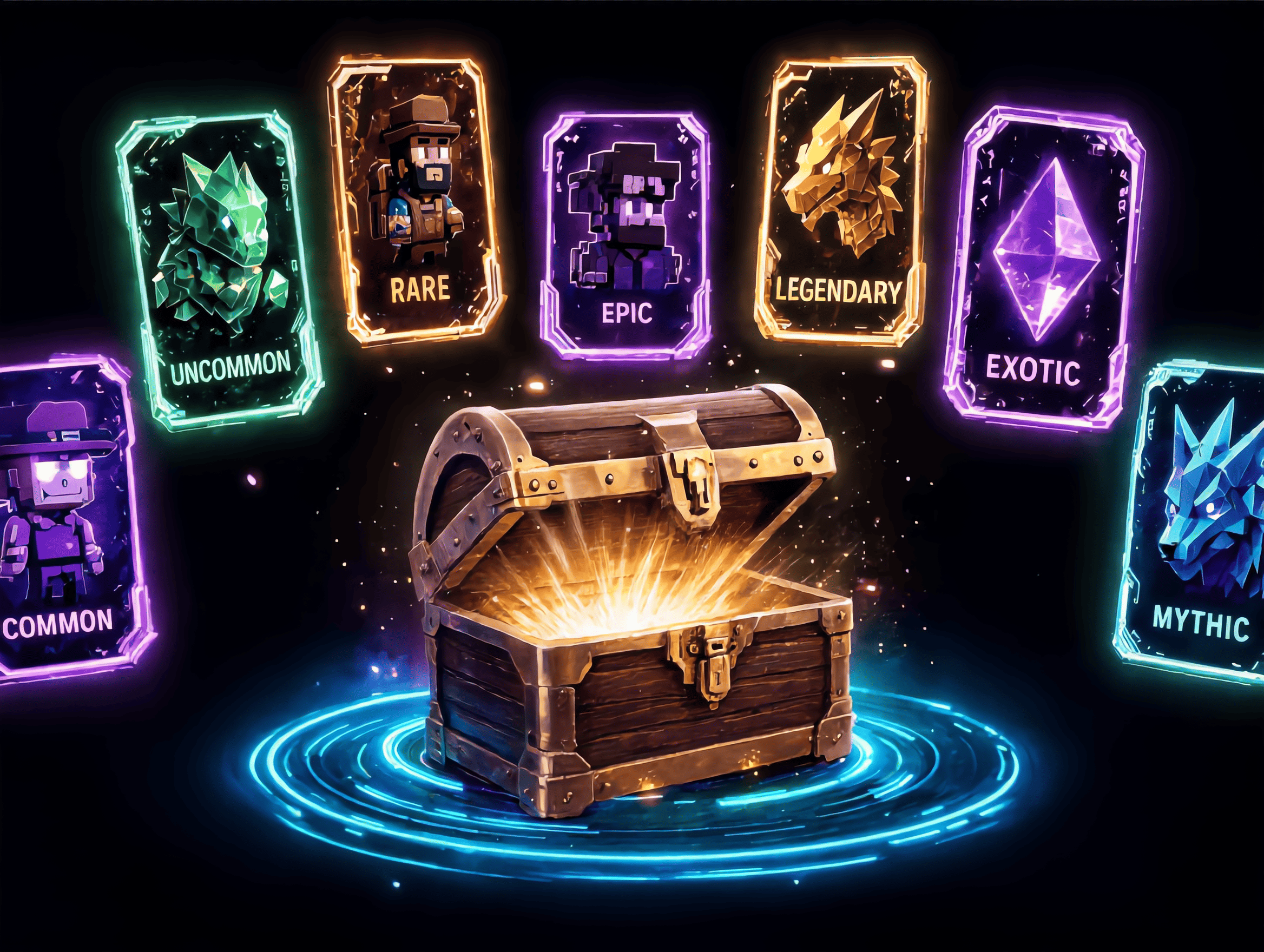

They took the most addictive mechanic in gaming, made it mathematically honest — and then attached a live cash market to every pull.
The short answer
On-chain lootboxes are randomized digital reward boxes resolved by verifiable blockchain randomness, with prizes minted as tradable NFTs. They are a genuine upgrade on hidden-odds game loot boxes — you can prove the draw was fair — but because the rewards have instant cash value, they sit far closer to the legal and psychological definition of gambling than anything on a console.
- Verifiable randomness (Chainlink VRF, block hashes) lets anyone audit that a lootbox draw was unbiased and untampered — something mainstream game loot boxes almost never offer.
- The prizes are NFTs with a live secondary-market price, so every pull has a real cash-out value — the exact feature regulators use to classify randomized rewards as gambling.
- Provable fairness changes the trust problem, not the reward psychology: the variable-ratio loop that research links to problem gambling is fully intact.
- Global regulation is a patchwork — from Belgium's criminal ban to disclosure-only regimes — and on-chain mechanics fit awkwardly into all of them.
Open a treasure chest, get a random prize. It is the oldest dopamine trick in video games, and for two decades it ran on blind faith: the publisher controlled the odds, the server, and the outcome, and you simply trusted that the rare skin really was rare. On-chain lootboxes blow that opacity apart. The randomness is generated and proven on a blockchain, the odds are published in a smart contract, and the prize lands in your wallet as an NFT you actually own. It is, by any honest measure, the most transparent version of the loot box ever built.
And that is exactly what makes it interesting — and dangerous. Because the same blockchain that makes the draw provably fair also gives the reward a price. Every item that drops can be listed, traded, and sold within seconds. An on-chain lootbox is therefore not just a fairer loot box; it is a randomized purchase with a guaranteed resale market attached. That combination — honest odds plus liquid payout — is what separates it from a console crate and pushes it squarely into the gravity well of gambling.
This is a breakdown of the whole phenomenon: how the mechanism actually works, why the reward science makes it so sticky, where the law currently stands, and why "provably fair" solves one problem while quietly sharpening another. If you are new to the surrounding world, it helps to first understand what a crypto casino is, because on-chain lootboxes are increasingly one of its core products.
What an on-chain lootbox actually is
Strip away the branding and the structure is simple. A smart contract sells you a sealed box for crypto. When you open it, the contract requests a random number from a verifiable source, maps that number onto a published table of rarity tiers, and mints the corresponding NFT to your address. Everything except your decision to buy happens in code that anyone can read.
The crucial component is the randomness. On a public blockchain, naive randomness is exploitable — validators can see and sometimes influence on-chain values, so a lazily built draw can be gamed. The industry's answer is a verifiable random function (VRF): a cryptographic method, introduced academically in 1999 and brought to Ethereum at scale by Chainlink in 2020, that produces a random result together with a proof that it was generated honestly. The contract only accepts the number if the proof checks out, which means no operator, validator, or player could have predicted or nudged it.
Real deployments already exist across web3 gaming. Chainlink VRF has been used to assign random traits to Axie Infinity's Origin Axies, to distribute Bored Ape Yacht Club's Mutant Serums, to "summon" Aavegotchi characters, and to power dedicated lootbox systems from studios like ChainSafe and various web3 game guilds. By one industry count, more than 4,500 gaming and NFT integrations now rely on verifiable randomness. The irony, as researchers have noted, is sharp: the blockchain games most people dismiss as fringe offer mathematically provable fairness, while the blockbuster console and mobile titles stuffed with loot boxes almost never do.
The provably-fair twist
"Provably fair" is the phrase doing the heavy lifting, and it deserves precision. It does not mean you are likely to win, or that the odds are generous. It means two narrow, verifiable things: the operator could not have predicted your result, and the operator cannot retroactively change it. Some systems prove this with a VRF; others use the hash of a future, unknowable block — the same principle behind a provably fair lottery seeded by a Bitcoin block that nobody can rig.
The everyday casino version of this is the commit-reveal scheme: the operator commits to a secret server seed by publishing its hash before you play, your own client seed is mixed in, and a nonce counts up with each draw. After the round, the server seed is revealed, you re-hash it, and you confirm it matches the commitment — proof the result was locked in before you acted. The demo below is a simplified, no-money illustration of that exact handshake.
Notice what the demo cannot hide: the legendary tier is vanishingly rare, and the honest odds make that brutally clear. Transparency, it turns out, does not blunt the pull — it sharpens it. When you can see that a one-in-three-hundred outcome exists and is real, the chase becomes more credible, not less.
The reward science under the hood
To understand why a provably-fair box is still hard to put down, you have to look at the brain, not the blockchain. Dopamine, contrary to popular shorthand, is not a "pleasure" signal so much as a prediction signal. Cambridge neuroscientist Wolfram Schultz showed that dopamine neurons fire in proportion to how much an outcome beats expectation — and, critically, that this response is largest and most sustained when the outcome is maximally uncertain. A coin-flip reward lights up the system far more than a guaranteed one. A lootbox is engineered uncertainty.
That uncertainty is delivered through what behavioral scientists, since Ferster and Skinner, call a variable-ratio reinforcement schedule: rewards arriving after an unpredictable number of attempts. It is the most persistence-inducing schedule known, and it is the literal mechanism of a slot machine. The empirical link to harm is not speculative. In a survey of more than 7,000 players, David Zendle and Paul Cairns found that the more people spent on randomized loot boxes, the more severe their problem-gambling scores — an association stronger than the link between problem gambling and several traditional risk factors, and one that has since replicated. Later lab work showed that rare rewards produce larger physiological arousal and a stronger urge to keep opening, mirroring how slot players react to big wins. For the human cost behind those curves, see our data-driven look at gambling addiction.
Provable fairness fixes whether the dice are loaded. It does nothing about whether you can stop rolling them.
On-chain lootboxes add a third accelerant that ordinary loot boxes lack: the collecting instinct. An NFT prize is not just a number on a server — it is an owned, displayable, scarce object. That recruits the same acquisition circuitry that drives every collector, layered on top of the gambling loop. Randomness, ownership, and a live market, braided together.
The cash-out problem regulators can't ignore
Here is the fault line. What usually decides whether a randomized reward is legally "gambling" is not the randomness — it is whether the prize has real-world value you can realize. Most console loot boxes sidestep this by forbidding cash-out; the rare skin is locked inside the game. On-chain lootboxes do the opposite by design. The reward is a tradable NFT with a live floor price, and that liquidity is provided by the NFT marketplaces that sit at the center of the crypto casino economy.
Courts have already seized on exactly this feature. An Austrian district court ruled that FIFA Ultimate Team packs constituted illegal gambling specifically because cards could be sold on a secondary market, giving them financial value. Belgium's 2018 determination similarly hinged on the convertibility of items. On-chain lootboxes don't merely risk crossing that line — they are built on the side of it that regulators worry about most.
| Property | Console loot box | On-chain lootbox | Slot machine | Verdict |
|---|---|---|---|---|
| Odds visible | Often hidden or buried | Published on-chain | Regulated disclosure | Transparent |
| Fairness proof | Trust the publisher | Cryptographic, auditable | Audited RNG | Verifiable |
| Cash-out | Usually blocked | Instant via NFT market | Direct payout | Gambling-like |
| Reward schedule | Variable-ratio | Variable-ratio | Variable-ratio | Identical |
The global rulebook is a patchwork
There is no single answer to "are these legal," because jurisdictions have landed in genuinely different places — and most wrote their rules before on-chain mechanics existed. Three broad models have emerged.
- Prohibition. Belgium classified paid loot boxes as gambling in 2018 and backs it with criminal penalties; major publishers pulled products rather than comply, though enforcement has been patchy. The Netherlands fined EA millions before its highest court overturned the penalty in 2022 under a "game-integration" test.
- Restriction. Brazil enacted a 2025 law banning loot box sales to under-18s from March 2026, and the EU's forthcoming Digital Fairness Act is expected to target randomized mechanics aimed at minors. A binding PEGI labeling change for "random items" also takes effect in 2026.
- Disclosure. China mandated probability disclosure back in 2017, with South Korea following; the UK and most US states allow loot boxes provided odds and spending are transparent. The United States still has no federal loot box statute at all.
Where on-chain lootboxes fall
Awkwardly, is the honest answer. A disclosure regime is the natural fit — on-chain boxes are more transparent than the law typically demands. But a prohibition regime that triggers on convertible value would catch them more cleanly than it ever caught console crates, precisely because the NFT payout is liquid by default. The same property that makes an on-chain lootbox technically superior makes it legally exposed.
So where does this leave on-chain lootboxes?
In a genuinely novel position: the most transparent randomized-reward product ever built, and simultaneously the one that hews closest to gambling's defining feature. Provable fairness is real progress — it kills the rigged-draw problem that haunted a decade of loot boxes. But fairness and safety are not the same word. An honest variable-ratio loop attached to instant liquidity is still a variable-ratio loop attached to instant liquidity, and the reward science says that is the combination most likely to produce compulsive engagement.
For builders and operators, the implication is not to retreat from the technology but to be clear-eyed about what it is. The transparency is a feature worth leaning into. The cash-out and the reward schedule are risks worth designing around — with visible odds, spending limits, age gating, and genuine off-ramps, not because a regulator demands it today, but because the durable products in this space will be the ones that treated player welfare as architecture rather than afterthought.
On-chain lootboxes only make sense once the surrounding ecosystem does. These two explainers are the place to begin.
Three things to hold onto
Provably fair is a trust upgrade, not a safety upgrade. Verifiable randomness removes one specific harm — a rigged draw — while leaving the psychological mechanics of the loot box completely untouched.
Cash-out is the whole legal question. The NFT payout that makes on-chain lootboxes exciting is the same feature that has historically tipped randomized rewards into the gambling category. Liquidity is the line.
The regulation is coming, and it won't fit cleanly. Most loot box law predates this design. Operators who build with disclosure, limits, and protection now will adapt far more easily than those waiting to be told.
On-chain lootboxes are what happens when you take gaming's most scrutinized mechanic, make it mathematically honest, and wire it directly into a financial market. That is a remarkable piece of engineering and a real ethical knot at the same time. Understanding both halves — the cryptography and the compulsion — is no longer optional for anyone serious about this corner of crypto gambling.